
· by Michael Blair, Nashville's Tile and Stone
A concrete patio looks like the perfect base for tile: flat, hard and already there. Outdoors, though, tile has to cope with rain sitting on it, summer sun heating it and winter freezes working at anything that holds water. The slab has to drain, the field of tile has to be allowed to move, and the mortar has to be in full contact. Here is what the tile industry’s guidance asks for on an exterior slab, why each part matters, and how we look at a patio before agreeing to outdoor tile on it.
Can a concrete patio take tile?
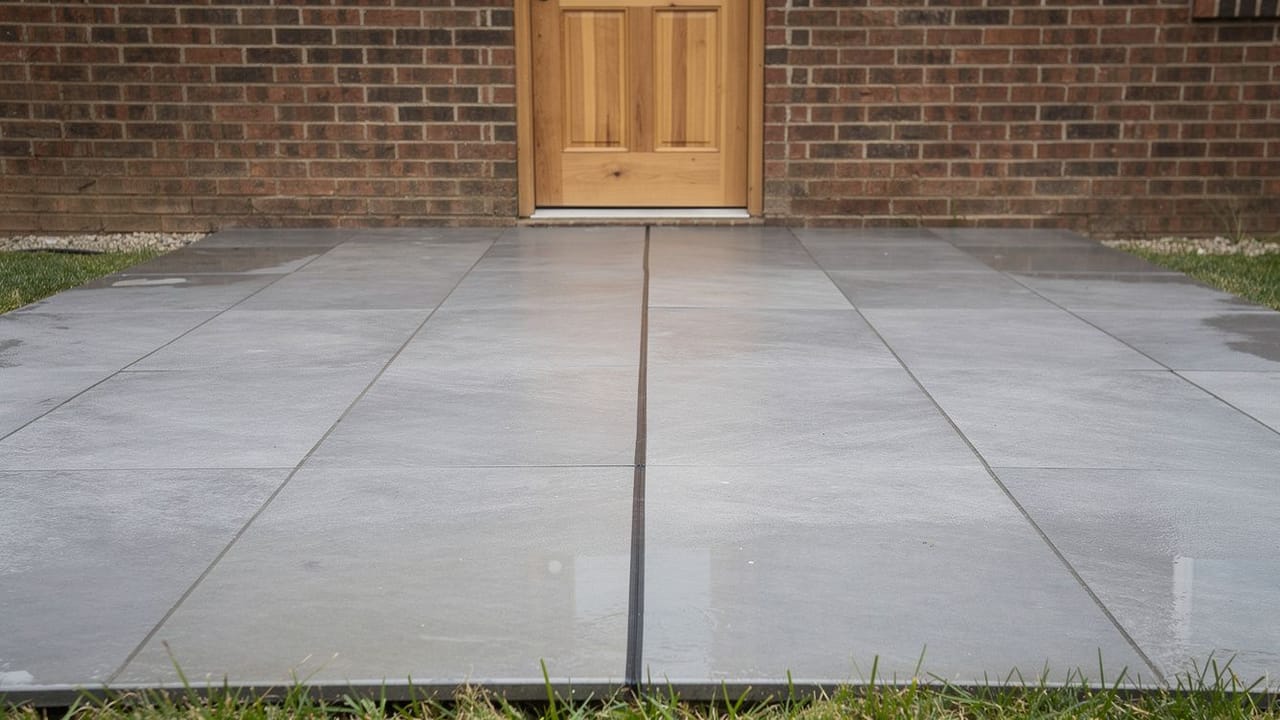
A concrete patio can take tile when the slab already sheds water, its cracks and joints are accounted for, and the tile goes down with movement joints and full mortar contact. Custom Building Products, the setting materials maker, lays out those requirements in its white paper WP145, Exterior Installations, from October 2020, citing the Tile Council of North America’s handbook throughout.
The part homeowners tend to skip is the slab itself. Tile is a thin layer bonded to whatever is underneath, so it inherits the slab’s slope, its low spots and its cracks. Before we agree to tile a patio, we walk it after rain or with a hose to see where the water goes, and we map the cracks and the slab’s own joints, because we plan the tile’s own joints around them. A patio that holds a puddle today will hold one on top of new tile too.
How much slope does a tiled patio need?
A tiled patio needs a quarter inch of fall per foot, by the current TCNA Handbook as the Custom Building Products white paper reports it, and any rain or moisture should be off the tile surface within 48 hours. That slope belongs to every exterior horizontal installation, not just pool decks or steps.
Most of that fall has to be in the concrete. We put the fall in the concrete rather than trying to build it up in the tile bed, so a patio poured dead level, or one that has settled back toward the house, gets its slope corrected before any tile, and on some slabs that is the bigger job of the two. Water that sits on tile works its way into grout and under the edges, and outdoors that is the water that freezes.
Why does outdoor tile need movement joints?
Outdoor tile needs movement joints because the tile, the mortar and the concrete expand and contract by different amounts as the temperature swings, and something has to give. The Tile Council of North America’s placement FAQ describes tile as a facade and says movement joints relieve those stresses. It points to detail EJ171 in the TCNA Handbook, says it cannot name the exact location or frequency for a given job, and notes that for exterior work the range from summer highs to winter lows has to be considered.
Custom Building Products is blunter. Its white paper calls movement joints required, not optional, names their absence as one of the largest causes of failure in exterior tile and stone, and gives a general guide of a joint every 8 to 10 feet in both directions. The joints are filled with a flexible sealant meeting ASTM C920 rather than grout, so they can move without cracking. Our post on why grout cracks covers what happens indoors when that room to move is missing.
What makes patio tile crack or come loose?
Patio tile cracks or comes loose mostly when one of those requirements was skipped and water found the gap. The Custom Building Products paper notes that freezing water expands by about 9 percent, so water held in a hollow under a tile, or in a low spot on the slab, pushes on everything around it each time it freezes. It also says regions with heavy freezing need a premium mortar with strong freeze-thaw performance.
Coverage is the other half. The paper says TCNA requires mortar contact of at least 95 percent between tile and substrate on any exterior or wet installation, and that back-buttering the tile alone does not count as coverage. Our post on porcelain tile mortar and coverage goes into how that contact is checked. For steps and porches before winter, see porch and step tile before the first freeze. If you are in Nashville or nearby and want a patio looked at before tile goes on it, send us a few photos of the slab.
Sources
- Custom Building Products, Technical White Paper WP145: Exterior Installations (October 2020) — TCNA Handbook: 1/4 inch per foot slope on exterior horizontal tile, water off within 48 hours; movement joints required per TCNA EJ171, general guide every 8 to 10 feet both ways, ASTM C920 sealant; at least 95 percent mortar coverage outdoors, back-buttering alone not coverage; freezing water expands about 9 percent; premium freeze-thaw mortar in heavy freeze regions
- Tile Council of North America, FAQ: Placement — Tile is a facade and movement joints relieve stresses from differing expansion and contraction; guidance in TCNA Handbook detail EJ171; TCNA cannot specify exact location or frequency; consider the summer-to-winter temperature range outdoors
FAQ
Tile Over a Concrete Patio: Slope, Joints, Mortar — questions
How do you tile over a concrete patio?
Start with the slab: it needs a quarter inch of fall per foot so water clears the surface within 48 hours, and its cracks and joints have to be accounted for. Then the tile goes down in a mortar suited to freezes, with at least 95 percent coverage and movement joints filled with flexible sealant, not grout.
How often do movement joints go in outdoor tile?
Custom Building Products gives a general guide of every 8 to 10 feet in both directions for exterior tile, and calls the joints required rather than optional. The Tile Council of North America says it cannot set an exact spacing for every job and points to detail EJ171 in its handbook, noting that outdoor temperature swings must be considered.
What thinset is used for outdoor tile?
Custom Building Products says regions with heavy freezing need a premium mortar with strong freeze-thaw performance, and that exterior installations need at least 95 percent mortar coverage between tile and substrate. Back-buttering the tile alone does not achieve that. Follow the mortar maker’s data sheet for the tile and the conditions it will face.
What slope should an outdoor tile patio have?
A quarter inch per foot, according to the TCNA Handbook as Custom Building Products’ exterior installations paper reports it, with rain and moisture clearing the tile surface within 48 hours. That fall should already be in the concrete slab, because the tile follows whatever surface it is bonded to.