
· by Michael Blair, Nashville's Tile and Stone
Marble and travertine take stains that porcelain shrugs off, because both are porous stones that drink in whatever sits on them. A ring under a plant pot, a dark patch where cooking oil landed, an orange mark from a can left on a shower ledge: each has a different cause, and each comes out a different way, if it comes out at all. Scrubbing harder or reaching for a strong all-purpose cleaner usually makes things worse. Here is how our natural stone crews work out what a stain is, what lifts it, and when a tile has to be honed or replaced instead.
How do you know what stained the stone?
You work it out from the stain’s color, its shape and where it sits, because the cause decides the treatment. The Natural Stone Institute’s stain removal guide calls identifying the stain the key to removing it, and says to ask what is near it, what color it is and what shape it takes.
Its descriptions are a good field guide. Oil-based stains from grease, cooking oil, milk or cosmetics darken the stone. Organic stains from coffee, tea, fruit, food or urine can leave a pinkish-brown mark. Iron and rust stains are orange to brown and follow the outline of whatever caused them: a can, a flower pot, a screw, a metal chair leg. Copper and bronze leave green or muddy-brown marks from moisture acting on nearby metal.
Two marks people call stains are something else. A hard-water ring is mineral sitting on the surface, and a dull, lighter spot where lemon, wine or vinegar landed is an etch, where acid has eaten into the polish. Etching is a surface repair, covered in our post on restoring a travertine floor.
What cleans each kind of stone stain?
Each kind of stain has its own first treatment, and the Natural Stone Institute lists them by type. For a fresh spill, it says to blot rather than wipe, flush with plain water and mild soap, rinse several times and dry. For a set-in oil stain, the oil has to be dissolved so it can be rinsed out, using one of a soft liquid cleanser with bleach, household detergent, ammonia, mineral spirits or acetone.
For organic stains indoors, the guide calls for 12 percent hydrogen peroxide, the strength sold for bleaching hair, with a few drops of ammonia. For mildew and algae, it gives a dilution of half a cup of ammonia, bleach or hydrogen peroxide in a gallon of water, and warns in capitals never to mix bleach with ammonia, because together they make a toxic gas.
Ink is where the color of the stone matters: bleach or hydrogen peroxide only on light stone, lacquer thinner or acetone only on dark. We try any of these first on a tile in a closet or under an appliance, because a dark marble can lighten where a light travertine does not.
- Oil: dissolve it, then flush it out
- Organic: 12 percent hydrogen peroxide and a few drops of ammonia
- Mildew and algae: half a cup of ammonia, bleach or peroxide per gallon
- Ink: bleach or peroxide on light stone, acetone on dark
- Rust and other metal: a poultice
- Never bleach and ammonia together
How does a poultice pull a stain out of stone?
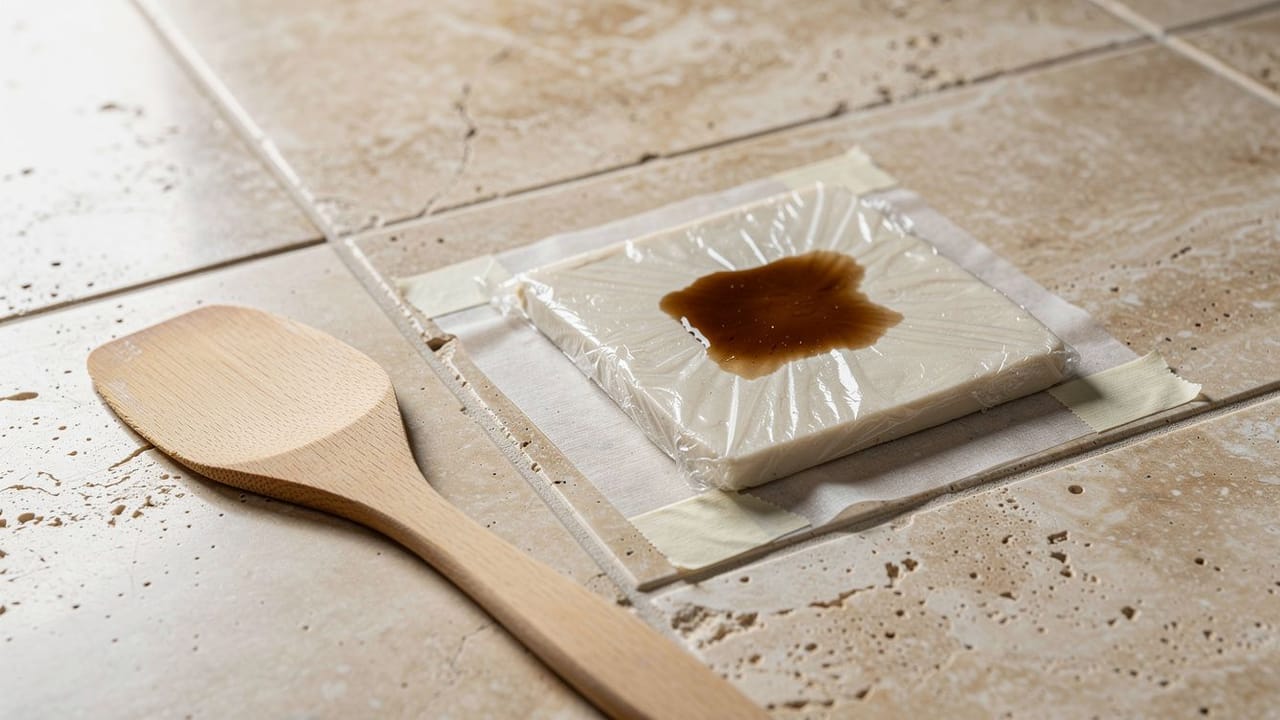
A poultice pulls a stain out by holding a cleaning chemical against the stone long enough to dissolve it, then soaking it up as the paste dries. The Natural Stone Institute’s poultice instructions describe stirring the cleaning chemical into a white absorbent powder until the paste is about as thick as peanut butter, spreading it 1/4 to 1/2 inch deep over the stain, covering it with plastic and leaving it for 24 to 48 hours. It may take more than one round, and some stains never come out completely.
The absorbent can be kaolin, whiting, diatomaceous earth, talc, chalk or white molding plaster, at roughly a pound of prepared poultice per square foot. The guide warns against using whiting or iron-bearing clays such as fuller’s earth with acid chemicals, because the reaction cancels the poultice out.
There are ready-made versions too. PROSOCO describes its Marble Poultice as a non-acidic blend of absorbent clays and detergents, mixed with water on site, left on for 4 to 48 hours to draw oil and other deep stains into the paste, and wiped off with a damp sponge. Its maker says it will not etch marble, limestone or other acid-sensitive stone, which matters on a polished floor.
When a stain will not come out of the tile
Some stains are in the stone for good, and the honest answer is to say so before anyone spends a weekend poulticing. The Natural Stone Institute says metal stains must be removed with a poultice and that deep-seated rust is extremely difficult to remove, leaving the stone permanently stained. Oil that has soaked through a whole tile for years may lighten without disappearing.
On a floor or shower wall, a stained tile can still be dealt with. A shallow stain may come off with the surface when the floor is honed. A single deep stain is usually cleaner to fix by cutting out that tile and setting a new one, which is part of our regrouting and tile repair work. Finding a match for a natural stone is harder than for porcelain, so we look at spare tiles from the original job first.
Once a stone is clean, a penetrating sealer slows the next stain down without stopping it. Our post on sealing tile and grout has the water-drop test for when a floor needs it. If you have a stain you cannot name, tell us where it is and what it looks like, and we will look at it before anything goes on the stone.
Sources
- Natural Stone Institute, Stain Removal — Identify the stain first; oil, organic, metal, biological and ink stains described with first treatments; 12 percent hydrogen peroxide and ammonia for organic stains; never mix bleach and ammonia; metal stains need a poultice and deep rust may be permanent
- Natural Stone Institute, Making and Using a Poultice — Chemical and white absorbent to a peanut-butter paste, 1/4 to 1/2 inch thick, covered with plastic for 24 to 48 hours; materials; about a pound per square foot; no whiting or iron clays with acids; some stains never come out
- PROSOCO, Marble Poultice — Non-acidic clay and detergent poultice mixed with water; 4 to 48 hours; draws out oil and deep stains; will not etch marble, limestone or acid-sensitive stone
FAQ
Getting Stains Out of Marble and Travertine Tile — questions
Will hydrogen peroxide damage marble tile?
The Natural Stone Institute lists 12 percent hydrogen peroxide with a few drops of ammonia for organic stains, so it is a recognized treatment. For ink it limits peroxide and bleach to light stone, because they can lighten dark stone. Test it first on a tile that does not show.
How long do you leave a poultice on stone?
The Natural Stone Institute says 24 to 48 hours, covered with plastic, so the chemical works and the absorbent dries and pulls the stain in. PROSOCO gives 4 to 48 hours for its ready-made Marble Poultice. A stubborn stain may need a second or third application.
Can rust stains be removed from travertine?
Sometimes. Rust and other metal stains have to be drawn out with a poultice, and shallow ones often lift. The Natural Stone Institute warns that deep-seated rust is extremely difficult to remove and the stone may stay stained, in which case replacing the tile is the cleaner fix.
Why does an oil stain make stone look darker?
The oil soaks into the pores of the stone and darkens it from inside, much like water does, except it does not evaporate. That is why surface cleaning does little. The oil has to be dissolved with a solvent or detergent and drawn out, often with a poultice.
Is an etch mark the same as a stain on marble?
No. A stain is something absorbed into the stone and usually darker or colored. An etch is a dull, often lighter spot where an acid such as lemon juice or vinegar ate into the surface. Etches are polished or honed out; a poultice will not remove them.