
· by Michael Blair, Nashville's Tile and Stone
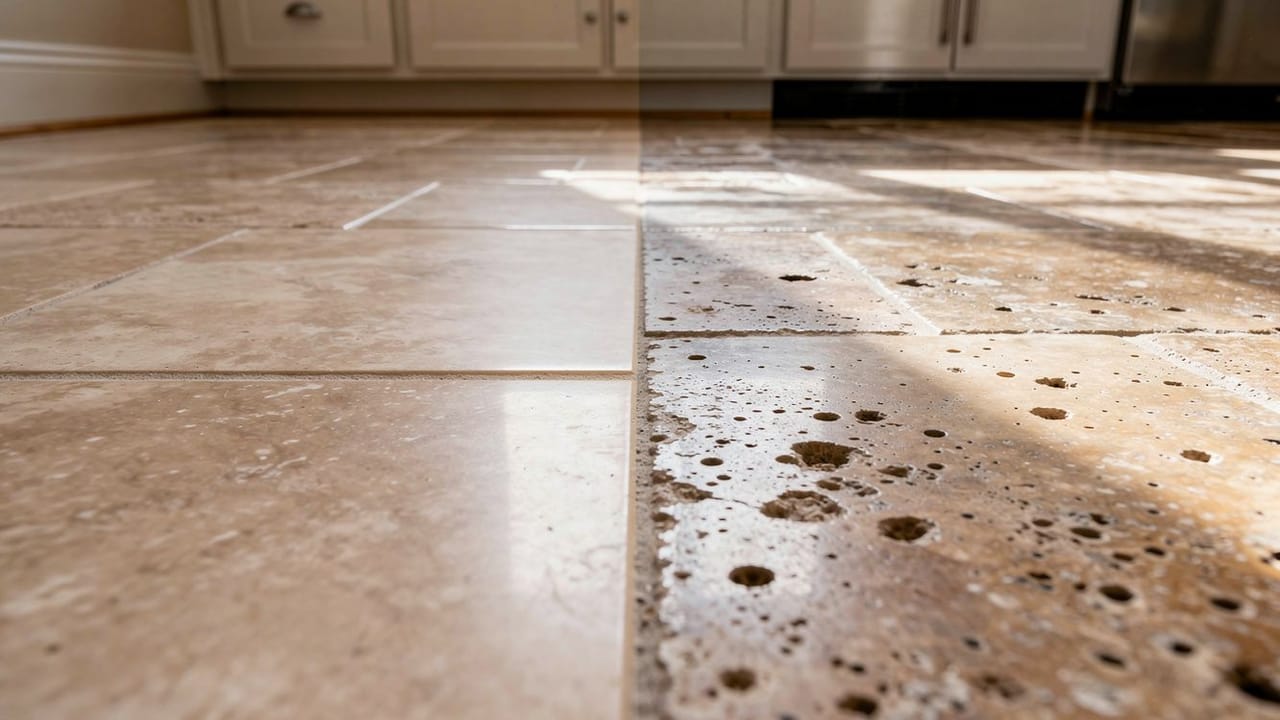
Travertine went down in a lot of Middle Tennessee kitchens, entries and bathrooms, and many of those floors now look tired: little holes opening across the tiles, dark specks of dirt packed into them, dull rings by the sink and a surface that no longer matches from room to room. Most of that is restorable. The work is not one product or one pass of a machine; it is a sequence, and doing it out of order is how a restored floor ends up looking worse in a year. What follows is how our natural stone crews approach a travertine floor, and where restoration stops and replacement begins.
Why travertine has holes, and why the fill comes out
The holes are part of the stone. The Natural Stone Institute’s handout on travertine voids explains that the voids come from gases trapped as the stone formed and are a characteristic of all true travertine, not a sign of a cheap grade. At the fabricator, voids that open through the face are usually filled with a cementitious or resin filler and ground flush; voids sealed inside the tile are left alone.
That is where new holes come from. The same handout describes a thin shell of stone roofing a hidden void until a small concentrated load breaks through it, and names rolling loads on hard wheels and spike heels as two of the more common causes. So a floor can be perfect at installation and start showing holes years later, usually along the paths people walk and roll chairs.
Factory fill also comes out on its own. In our experience the cement fill in older travertine shrinks, wears down a little faster than the stone around it, and loosens under foot traffic and wet mopping, leaving a shallow cup that collects dirt. Once a floor has a scattering of open and half-empty holes, cleaning alone will not make it look even again.
The steps, in order
Restoration starts with a deep clean, because nothing that follows will bond or look right over old wax, topical coatings and the grime packed into every hole. The stripped floor shows us what we are actually dealing with: how many voids are open, which tiles are cracked or hollow, and how much of the dullness is wear versus etching.
Then the holes are filled. Travertine fillers are matched to the stone’s color and pressed into each void slightly proud of the face. Rust-Oleum’s Miracle Sealants Travertine Filler Kit data sheet shows why the details matter: it calls for a surface free of wax or sealer, says to overfill larger holes slightly to offset shrinkage, notes that larger holes or cracks may need a polyester or epoxy resin, and says the product dries to a matte finish. That last point is one reason the floor gets honed after filling, not before; grinding the fill and the stone together leaves them at one level and one sheen.
Honing comes next, with diamond abrasives run in progressively finer grits, which takes off the worn surface, light scratches and most etch marks, and flattens lippage between tiles. If the floor is going back to a polished face, polishing follows the hone. Sealing is last, once the stone is clean, filled, finished and fully dry.
- Deep clean and strip old coatings
- Fill open voids, a little proud
- Hone with diamonds, coarse to fine
- Polish, if the floor will be polished
- Seal the dry, finished stone
Honed or polished, and acid on the stone
The choice between a honed and a polished finish is about looks and upkeep. Honed travertine has a soft, flat sheen that hides fine scratches and wear paths; polished travertine reflects light and shows color more deeply, and it also shows every dull spot and scuff. We do not tell anyone one finish is safer underfoot. Slip resistance depends on the specific stone, the specific finish and what is on the floor, and the Tile Council of North America’s DCOF frequently asked questions notes that a DCOF number does not predict whether a given person will slip. For a kitchen or bathroom floor that gets wet, ask for the wet DCOF of the finish you are considering, and judge it against the interior wet classification that page describes.
Acids are the other half of the decision. Travertine is a calcium carbonate stone, and the Natural Stone Institute’s care guidance warns that products containing lemon, vinegar or other acids may dull or etch calcareous stones. Etching is the surface of the stone being changed, not a stain sitting on it, and it shows far more on a polished face than on a honed one. A household that cooks with citrus and wine, or cleans with vinegar out of habit, will keep a honed floor looking even longer.
What cannot be restored, and keeping it after
Restoration works on the face of the stone. It does not fix a tile that sounds hollow because it lost its bond, a crack running across several tiles from movement in the slab or subfloor below, or broken corners and edges. Those tiles are cut out and replaced, and if the travertine is no longer available, we look for the closest match and place the new pieces where they show least. A crack pattern that follows the floor structure is a setting problem first, and our floor tile page covers what has to be under a stone floor for it to stay put. Deep oil or rust stains that have soaked through the stone may lighten with a poultice but sometimes do not come out at all.
After the work, the floor needs a gentle routine. The Natural Stone Institute recommends a neutral cleaner, stone soap or a mild dishwashing detergent in warm water, and warns that too much cleaner leaves a film and streaks. A penetrating sealer slows staining but does not stop etching; the Miracle Sealants 511 Impregnator data sheet lists travertine as a suitable surface and says plainly that it will not stop acid etching, and it asks for the area to be kept dry and free of staining materials for 72 hours after application. When a sealer needs renewing depends on the product and the traffic, so we test with a few drops of water rather than going by a calendar; sealing tile and grout explains that test and what sealer can and cannot do.
Sources
- Natural Stone Institute, Travertine Voids technical handout (2019) — Why travertine has voids, how they are filled at fabrication, and how hidden voids break open under concentrated loads
- Natural Stone Institute, Learn About Cleaning Products for Natural Stone — Acids may dull or etch calcareous stones; neutral cleaners recommended; excess cleaner leaves film
- Rust-Oleum Miracle Sealants, Travertine Filler Kit Technical Data MS-48 — Surface prep, overfilling for shrinkage, resin for larger holes, matte cure
- Rust-Oleum Miracle Sealants, 511 Impregnator Technical Data MS-01 — Suitable for travertine; will not stop acid etching; 72 hours dry after application
- Tile Council of North America, Dynamic Coefficient of Friction FAQ (ANSI A326.3) — Wet DCOF classification; DCOF does not predict whether a person will slip