
· by Michael Blair, Nashville's Tile and Stone
Tearing out a tile floor is loud, dusty and slow, so it is fair to ask whether the new tile can just go on top. Often it can. The makers of tile mortar publish instructions for it, and we do it when the floor underneath is right for it. The catch is that the old tile becomes part of the new floor’s base, and anything wrong with it carries straight through to the new tile. This post covers how we decide on a floor tile job whether the old tile stays, how it gets prepared, and the details that are easy to forget until the bathroom door will not close.
When can new tile go straight over old tile?
New tile can go over old ceramic tile when the old tile is firmly bonded to a rigid floor, flat, clean, and on a structure stiff enough for tile. LATICRETE’s data sheet for installing tile and stone over existing surfaces names several of its own mortars for setting new ceramic tile or stone over existing ceramic tile and cement terrazzo, indoors or out. It is one maker’s instructions for its products, but the conditions it sets are the ones that matter on any floor.
Those conditions are strict. The old tile has to be stuck fast to a rigid substrate. The floor below has to be stable, clean and dry, and stiff enough to meet a deflection limit of L/360 for tile and L/480 for natural stone, so stone asks more of the floor than ceramic or porcelain does. A cushioned vinyl floor will not hold tile at all, and carpet or water-soluble vinyl glue has to come up down to a sound surface.
Custom Building Products lists existing ceramic tile as a suitable surface in its data sheet for T1-60 tile adhesive, limited to interior dry areas for that product. Every product sheet sets its own limits, so we read the one for the mortar we are using on that job.
How do we tell if the old tile is sound?
We tap it. Every tile gets a light knock with the handle of a tool or a coin, and a solid tile sounds sharp while a loose one sounds hollow. A hollow tile has lost its bond, and the new tile set over it would be sitting on something that moves. If a few tiles are hollow, the bond is failing across the floor, and that floor comes out.
Cracks tell us about the structure. A crack that runs in a line across several tiles usually follows movement in the floor below, whether a joist that bends too much or a crack in the slab. New tile laid on top would crack along the same line. Our post on tile that lifts or tents off the floor covers what causes tile to let go in the first place, and the one on tile over a wood subfloor covers how stiff a framed floor needs to be.
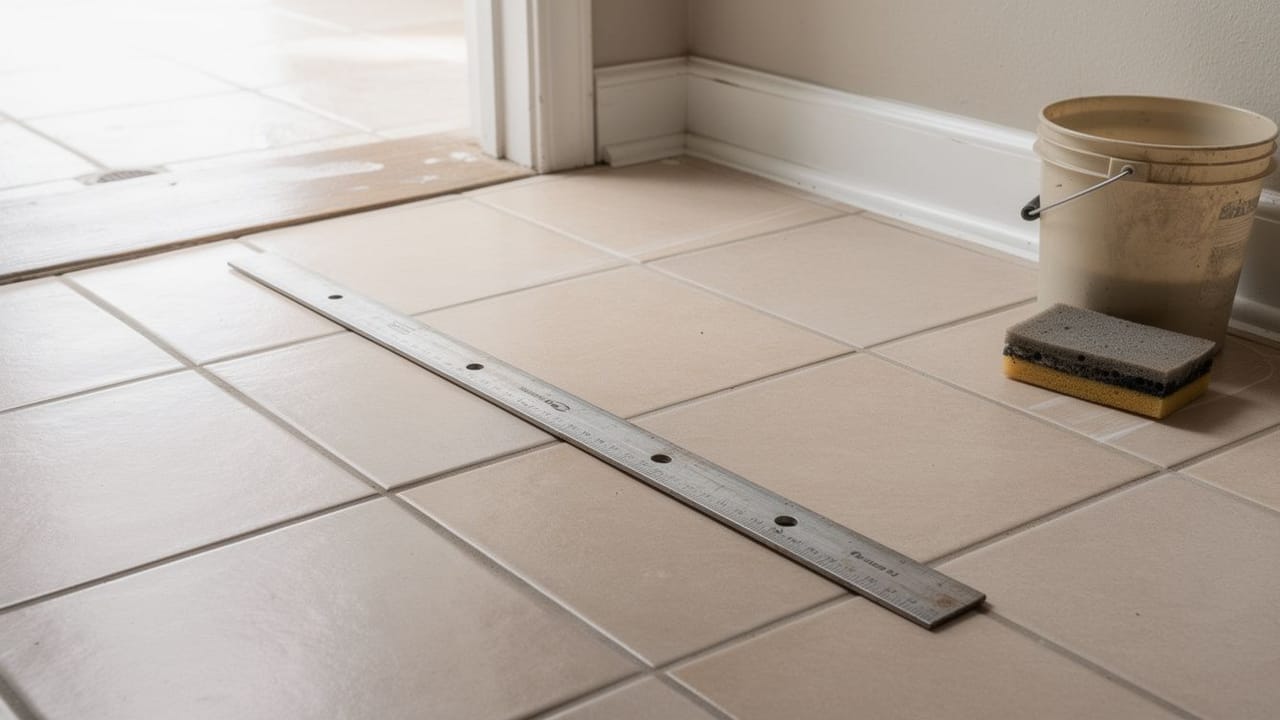
We also check how flat it is with a long straightedge. A lipped edge or a dip in the old floor carries into the new one unless it is ground or leveled first. Grout that is just stained or crumbling is not, on its own, a reason to retile; regrouting may be the better fix.
How is old tile prepared for the new layer?
The glaze has to be cleaned and roughed so the mortar can grip it. LATICRETE calls for removing grease, wax and oil, then scrubbing with a TSP solution or electric dishwasher detergent in hot water, rinsing, and letting the floor dry. Custom Building Products says to mechanically abrade well-bonded ceramic tile, rinse it and let it dry, and its data sheet for LevelQuik Advance, a self-leveler, says glazed tile, terrazzo or polished stone should be roughened or scarified before that product goes down.
A primer is often part of it. LATICRETE permits and recommends one over existing tile and names its own primer for the purpose. Whether a primer is required depends on which mortar is used, so the mortar’s data sheet decides.
Setting the new tile takes more care than setting it on a slab. LATICRETE describes keying a thin skim coat of mortar, about 1/16 inch, into the old tile first, then combing on more mortar and beating the new tile in. For large tiles it adds a skim coat on the back of each tile and a beating block. Where an old floor might be vinyl or another resilient sheet rather than ceramic, Custom Building Products warns not to sand flooring that contains asbestos, which is a reason to have an older resilient floor tested before anyone abrades it.
Height, doorways and the rooms where we take it out
A second layer raises the floor by the thickness of the new tile plus its mortar, and that height shows up everywhere the floor meets something. Doors may need trimming. The joint with the next room needs a transition. A toilet flange ends up below the new floor and needs an extension, and a dishwasher that fit under the counter may no longer slide out. We measure all of that before we agree to tile over.
Some floors come out anyway. We do not tile over old tile in a shower, because the waterproofing is behind the old tile where no one can see or test it; our post on waterproofing a shower explains why that layer decides how long a shower lasts. Hollow tile, cracks that follow the framing or slab, or a floor that already sits too high at the door all mean starting from the substrate.
For a floor in Nashville or the towns around it, tell us about the floor you want to replace. We will tap it, check it for flat, look at the doorways and tell you straight whether the old tile can stay.
Sources
- LATICRETE, TDS 135: Ceramic Tile and Stone Over Existing Wall and Floor Surfaces — One maker’s instructions: named mortars for tile over existing ceramic tile and terrazzo; existing tile firmly bonded to a rigid substrate; deflection L/360 for tile and L/480 for stone; degrease and scrub with TSP or dishwasher detergent; primer permitted and recommended; skim coat, comb and beat in
- Custom Building Products, TDS-190: T1-60 Economical Tile Adhesive — Existing ceramic tile listed as a suitable substrate in interior dry areas; mechanically abrade well-bonded ceramic tile, rinse and dry; do not sand flooring containing asbestos
- Custom Building Products, TDS-524: LevelQuik Advance — Existing glazed tile, terrazzo or polished stone to be roughened or scarified before the self-leveler
FAQ
Tiling Over Existing Tile: When It Works — questions
Do you need a primer to tile over tile?
It depends on the mortar. Some makers permit and recommend a primer over existing tile, and others rely on roughing the glaze and a mortar rated for the job. Whatever product is used, the old tile still has to be degreased, scrubbed, rinsed and dried, and its own data sheet decides whether primer is required.
What adhesive do you use for tile over tile?
A mortar or adhesive whose data sheet lists existing ceramic tile as a suitable surface. LATICRETE, for example, names several of its own mortars for tile over tile, and Custom Building Products lists existing ceramic tile for one adhesive in interior dry areas. Follow that product’s preparation steps and limits exactly.
Can you tile over cracked tile?
Not when the cracks run across several tiles in a line, because that usually means the floor below is moving and the new tile would crack in the same place. A single tile cracked by a dropped pan can be replaced first. Hollow-sounding tiles are also a stop sign, since they have lost their bond.
How much height does tiling over tile add?
The thickness of the new tile plus the mortar under it. That can be enough to bind a door, leave a lip at the next room, drop the toilet flange below the floor, or trap a dishwasher under the counter. Measure every doorway, transition and appliance before deciding to tile over the old floor.
Should I remove old tile or tile over it?
Tile over it only if every tile sounds solid when tapped, the floor is flat, there are no cracks running across several tiles, and the added height works at doors and appliances. If any of those fail, or it is a shower, remove the old tile and start from a sound substrate.